Classroom Environment
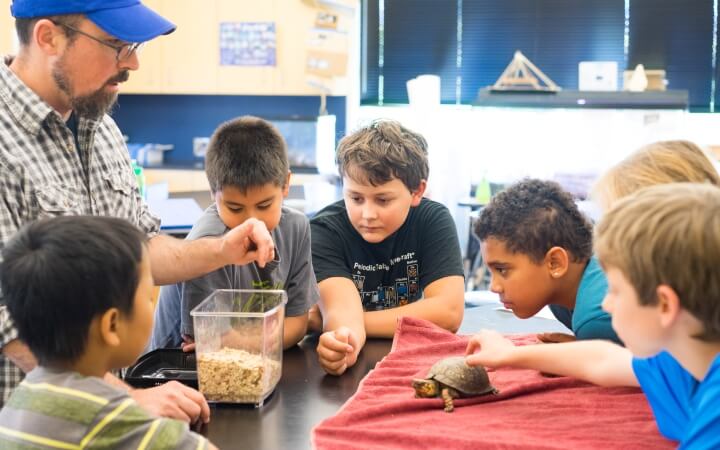
The Janus difference starts by providing the most appropriate learning environment for each of our students.
Classes are formed primarily by student’s learning needs and opportunities for growth in socially appropriate groups by age and grade.
Janus believes that there is not one program or one type of method that works well for all students. To help customize the learning experience, we identify each student’s strengths and opportunities for growth through a neurodevelopmental model.
Assessment is a critical tool at Janus that informs our instructors, parents, and outside professionals about a student’s performance. Instructors use data from these assessments to develop and adjust individualized programs and track progress. Students who are below grade level in reading are progress monitored monthly in all Divisions; students in Lower and Middle Division working below a sixth-grade level in math are also progress monitored on a monthly basis.
Throughout the year, we provide families with in-depth feedback that demonstrates their student’s performance and how they progressed to meet their goals.
Our Philosophy & Teaching Methods
The Janus School Philosophy is rooted in five foundational beliefs:
- We believe every student is unique, and careful assessment which identifies each student’s learning profile is critical to a successful individualized educational program.
- We believe the focus of instruction should always be on the student. No single educational program can serve all students with learning differences; therefore, we build each student’s program around their strengths and weaknesses.
- We believe the cornerstone of academic and personal success is a highly developed relationship between teacher and student that empowers the student to develop self confidence in the context of both academic and personal growth.
- We believe that when given the right strategies, students with learning differences will work successfully towards mastery of the skills they find most difficult.
- We believe language processing and social-communication skills are the key to academic and personal success and that these skills must be addressed, learned, and practiced.
Janus believes that there is not one program or one type of method that works well for all students. With solid grounding from a neurodevelopmental lens utilizing the research of All Kinds of Minds, Michelle Garcia Winner’s Social Thinking, Tera Sumpter, Russell Barkley, and others, our teachers differentiate instruction with a strong understanding of each student’s unique learning profile and how learning and language relate.
The cornerstone of the Janus approach is a neurodevelopmental model that heightens instructional teams’ abilities to define a student’s greatest areas of need rather than relying purely on a diagnosis. Every person has strengths and weaknesses among these constructs which affect teaching, learning, retention, and self-regulation:
- Executive function
- Language
- Social/Emotional Thinking
Many students at Janus struggle with some aspect of language; whether phonics, phonology, comprehension, or processing, expressive or receptive. With Orton-Gillingham and Diana Hanbury King’s Writing Skills as the foundation of instruction, a common and consistent approach to the essentials of reading and writing are promoted school-wide.
The Multisensory Math Program, developed by Marilyn Zecher, M.A., CALT, is Orton-Gillingham-based and applies strategies from reading instruction to conceptually-based math instruction. Instructional language is emphasized and provides consistency in instruction from year to year. Furthermore, a Concrete-Representational-
All the teachers at Janus utilize the Orton-Gillingham method. Students reading independently at a kindergarten to third-grade level focus on decoding, encoding, and comprehension skills. At the fourth- to eighth-grade independent level, the focus is on morphology and comprehension, while at the ninth-grade level and above, elements of Orton-Gillingham related to morphology and advanced vocabulary are incorporated to support independent readers.
Instruction at Janus is process rather than product-oriented to teach students how to learn, move through difficulty, and build confidence. Our goal is to develop independent learners at all levels with the ability to complete daily homework and long-term projects on-time and independently. Assistive technology is a powerful tool we use as an accommodation and to support remediation and engage learning.
How We Assess Students
Assessment at Janus provides instructors, parents, and outside professionals relevant information about a student’s progress and skill development. Beyond frequent communication between home and school, formal assessment and detailed narrative reports are sent to families twice per year.
Standardized achievement testing, informal assessment, progress monitoring measures, and grades provide instructors diagnostic information for developing individualized, dynamic instructional programs for each student. This information also provides parents with feedback and quantitative data for reevaluation and placement purposes.
Measures of Academic Progress (MAP) assessment is completed at the beginning and the end of the year as benchmark testing to guide instruction and monitor students’ individual progress and continuum of learning. Independent reading levels are also assessed at the beginning and end of each academic year using DRA-3 (Developmental Reading Assessment, 3rd Edition) or IRI (Informal Reading Inventory) depending upon grade level as well as academic ability. Acadience Reading and Math materials are also used for progress monitoring students who are working below grade level.
In addition to the testing completed at Janus, the PSAT and SAT are offered to Upper Division students. Testing accommodations are submitted to College Board by The Janus School based upon a student’s psychoeducational evaluation.
Narrative reports are sent to families two times per year. The Initial Report outlines a student’s Annual Areas of Focus based on the neurodevelopmental model and identifies individualized measurable goals for each class. The Final Report provides quantitative and qualitative measures of success for each goal, highlighting the student’s progress, effective learning accommodations, and provides recommendations for next steps. In addition to these formal reports, families receive a summary document of the Mid-Year conference in which progress toward those goals is noted.
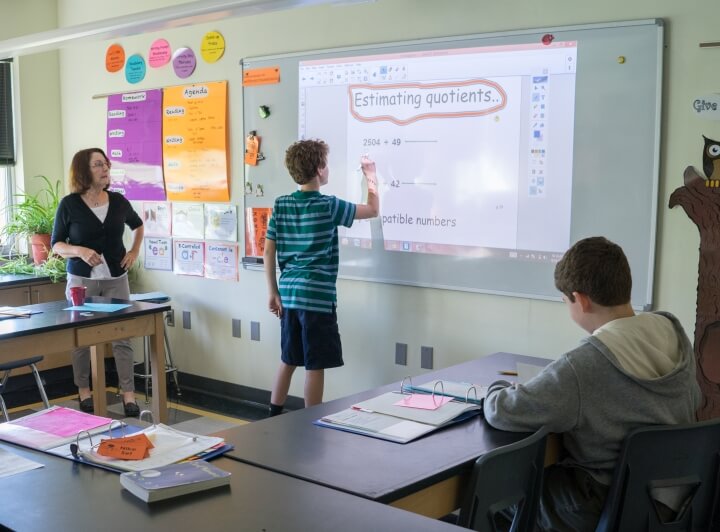
Visit a Class
We welcome you to visit Janus and see our classrooms in action.
Contact us today to schedule a tour or sign-up for our next Open House.